

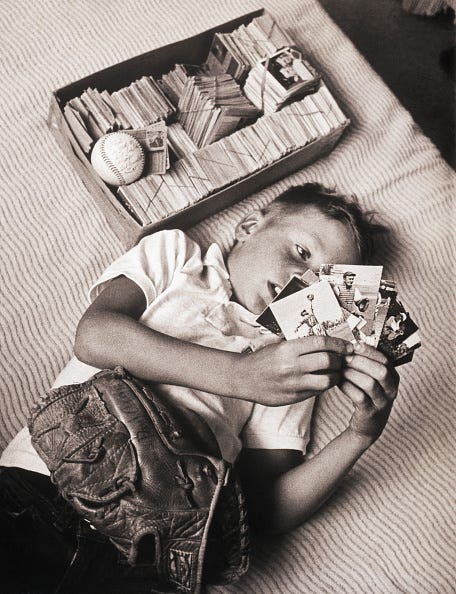
As a kid collecting baseball cards in the 1980s, I cared about only three things: my favorite players, my favorite team, and the cards I needed to complete the set.
Rookie cards and mint condition meant little to us. My friends and I never stuck our cards in our bike spokes, but we didn’t worry about keeping them perfect either. We rubber-banded stacks, stuffed them in our pockets, and carried them to school to show and trade.
We never considered their monetary value. The worth was in the player on the card.
The front of the card got most of the glory, of course. But I was always drawn to the back.
The Back of the Card
As a young baseball fan, I remember watching a Red Sox game one Saturday afternoon. I criticized an aging Carl Yastrzemski after he weakly popped up to the catcher to finish hitless for the day.
My dad quickly corrected me. “Yaz,” he explained, had been one of the best players in baseball for years. I was just seeing him at the very end.
Later that summer, I noticed Yastrzemski’s card as I opened a new pack Mom had just bought us in the Kmart checkout aisle. I flipped it over and saw line after line of tiny print with his yearly stats: 1961 RED SOX, 1962 RED SOX, … 1980 RED SOX.
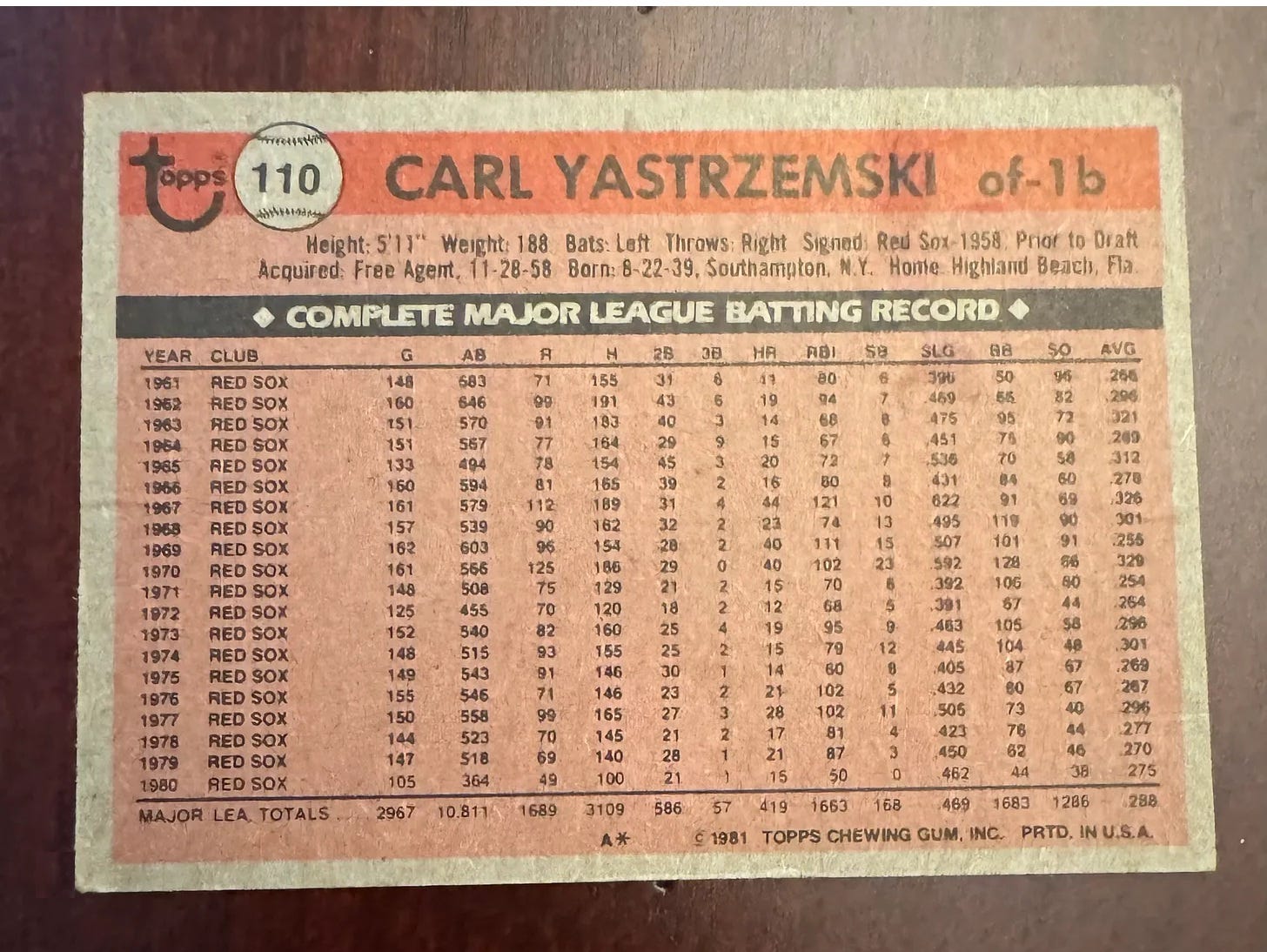
The numbers were impressive: 40-home-run seasons, 100-RBI seasons, batting averages over .300.
But what struck me even more was the sameness. The steadiness. Twenty years that all read the same way: one uniform, one city, one story.
I did not have words for it then, but the back of Yaz’s card was teaching me something. His greatness was not only in the numbers. It was in the long attachment those numbers recorded. A life gains meaning not only from achievement, but from belonging somewhere long enough to be known, needed, and shaped by a place.
Years later, when I took my own family to a game in Boston, I was not surprised to find Yastrzemski honored with a statue outside Fenway Park.
When Stars Stayed Put
I saw only the last few years of Yaz’s career, but I grew up in an era of classic one-team greats.
George Brett. Robin Yount. Mike Schmidt.
Don Mattingly. Kirby Puckett. Alan Trammell.
Tony Gwynn. Cal Ripken.
I rooted for players whose identity was bound up with one team and one city. I never wanted them anywhere else.
Maybe that is because I already knew the sting of seeing favorites leave. My Dodgers had done it to me: first Steve Garvey, then Steve Sax, and eventually Orel Hershiser.
Maybe that is why my strongest connection to the Dodgers wasn’t with a player at all, but with longtime manager Tommy Lasorda. He liked to say, “I bleed Dodger blue, and when I die, I’m going to the big Dodger in the sky.” Coming from Lasorda, it did not sound like a marketing line. It sounded like a man describing where he belonged. His 70-plus seasons with the organization made “Dodger blue” feel less like a team color than a lifelong commitment.
Loyalty in the Lean Years
Looking back now, I have even more respect for those one-city legends.
Any relationship that spans 20 years will be tested.
Cal Ripken won a World Series and the league MVP award in only his second full season with the Orioles. But just five years later, his Baltimore team lost its first 21 games and finished dead last at 54–107.
Nearly all of those one-team greats played on last-place teams at some point, and many went long stretches without appearing in the playoffs, let alone winning a championship.
Yet they are not remembered for complaining about their circumstances, using free agency as leverage, or demanding a trade when their team fell into the cellar.
They stayed. And over time, the staying became part of the story.
The Choice to Stay
There is a player in Cleveland today who is cut from that same cloth: José Ramírez.
Ramírez grew up poor in the Dominican Republic and signed with Cleveland as an unheralded 17-year-old. At 5-foot-9, many scouts saw him as a utility infielder. Instead, he became one of the best all-around players in baseball.
When the time came to cash in, Ramírez did something that now feels almost old-fashioned: he stayed. In 2022, he chose Cleveland when nearly everyone around baseball believed he could have made more elsewhere. Then in 2026, he chose Cleveland again, agreeing to a deal that could keep him there through 2032.
Ramírez is already on his way to Cleveland legend status. It is easy to imagine his statue outside Progressive Field one day. But more than any future honor, Cleveland has become home.
When asked why he stayed, Ramírez said his family had built a life there and that he owed the city a great deal. He was grateful for the way Cleveland’s fans had stood by him—support he knew could not be taken for granted.
Where Loyalty Still Lives
Earlier this year, my son’s school honored its high school basketball coach for his 500th victory. Current and former players went down to the court for a group photo, a visible reminder of the hundreds of young men he had influenced over 22 seasons at the school.
Before taking that job, he had bounced around five different college basketball programs over 19 years, never quite settling, never staying more than six years in one place. But once he found where he belonged, it became his one story.
I looked around and saw pride on faces all over the gym.
I saw the long-time math teacher who had met the coach at a Christian retreat years earlier. He was the one who urged him to step off the college basketball carousel and take the job at an all-boys Catholic high school.
I noticed the school’s beloved geography teacher leaning against the wall in his customary sport coat, looking as if he had stepped right out of Goodbye, Mr. Chips.
There was the PE teacher who had been at the school nearly 40 years and still looked as if he could outrun any student in the mile.
I saw younger teachers in the bleachers who had only been there a couple of years but had already caught the culture, men who seemed to know they had found their place.
Reading the Back of the Card
Later that night, I pulled up the school website to read more about the coach’s career. Before long, I found myself clicking through the faculty directory, reading each bio page, the school’s version of a baseball card.
Each “card” included the year the person had joined the school: 1989, 1990, 1992, 1998, 2000, 2004. One long tenure after another.
I thought of the family-owned company where I work. When we introduce ourselves to a customer, each person usually begins by mentioning how long they have been with the company. No one planned it that way. The habit emerged naturally as more of us stayed, built something together, and began to see those years as part of the story.
Some things can only be built the slow way.
If you look around and find yourself among people who stayed, built, and belonged, you are looking at wealth the market cannot measure.
Sharing Midwestern stories of faith, family, work, and sports
As an Indians fan, I’m glad you mentioned Jose Ramirez. He has really endeared himself to the city and embodies the blue collar ethic of the area. Always hustling, always giving maximum effort, bringing his lunchpail to work every day. Doesn’t complain. Works hard. Produces.
He’s the most underrated and (outside of Cleveland) under-appreciated star in the league.
Definitely something special about turning a card over and seeing so many years on the same team. Appreciating loyalty in sports isn’t an unusual sentiment, but I’m not sure I’ve ever heard it framed through the lens of the back of a baseball card. Great article!